Real-time feedback on how your body responds to food
Key to Health combines a breath sensor, an AI agent, and a Mediterranean-inspired dietary approach to create something most programs can't: a personalized, objective connection between what you eat and how your metabolism responds.
Most weight management programs track inputs — calories consumed, steps taken, meals logged. Key to Health measures something different: your body's metabolic response to the choices you've already made. No calorie counting. No food logging. No guesswork.
The program is built around three components: a breath sensor that reads your metabolism in real time, an AI agent that learns your patterns and provides personalized guidance, and a dietary approach rooted in Mediterranean-style eating principles. Together, they create a feedback loop that helps you build lasting dietary habits.
The device
A breath sensor that reads your metabolism
The Key to Health breath sensor is a small, handheld device that measures acetone in your exhaled breath — a naturally occurring byproduct of fat metabolism. The measurement takes seconds: breathe into the device, and your reading appears on the app.
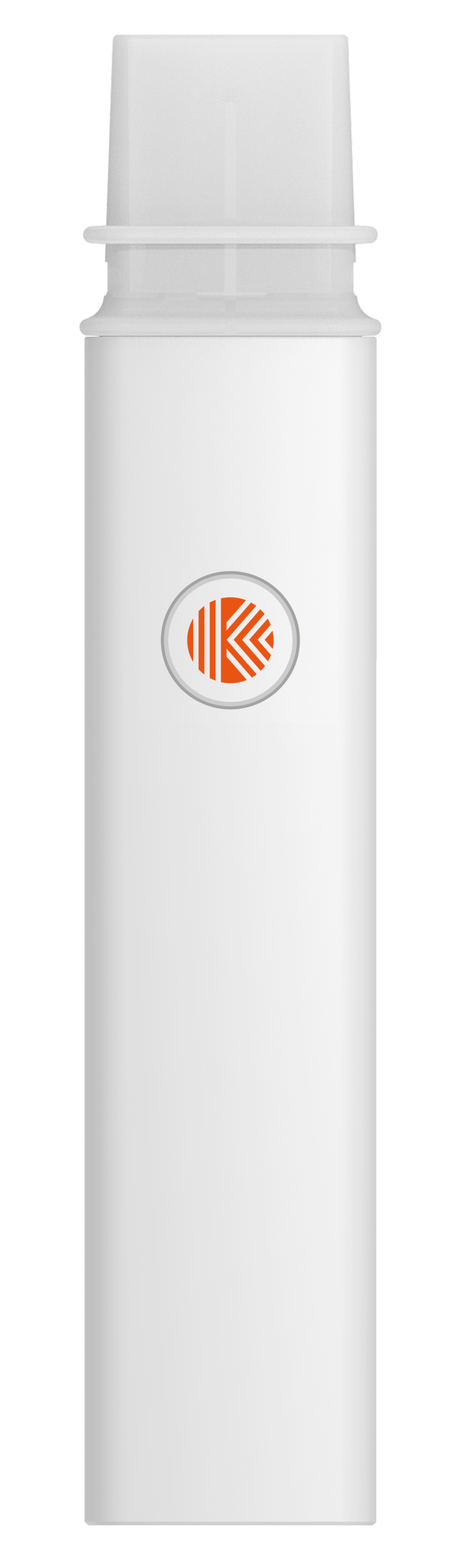
The Key to Health breath sensor is a small, handheld device that measures acetone in your exhaled breath — a naturally occurring byproduct of fat metabolism. The measurement takes seconds: breathe into the device, and your reading appears on the app.
Breath acetone has been studied as a biomarker of fat metabolism since the 1960s. The relationship between breath acetone concentration and rate of fat oxidation has been validated across multiple independent research groups and dietary patterns — not just low-carbohydrate diets.
Learn about the scienceThe AI
Meet KEY — your personal metabolic AI
KEY is an AI agent built into the Key to Health app. It analyzes your breath measurements, behavioral patterns, and any additional context you share — like what you ate, how you slept, or data from other wearables — to provide personalized insights about your metabolism and dietary choices.
After each breath measurement, KEY provides feedback tailored to your personal trends — what's working, what's changing, and what to consider next. You can add context via text or voice about what you ate or how you're feeling, and KEY incorporates that into its analysis.
KEY doesn't prescribe a rigid plan. It meets you where you are and helps you understand how your body responds to your specific choices — so you can make informed decisions that work for your life.
The mechanism
A feedback loop that builds lasting habits
The reason most programs fail long-term isn't lack of information — it's lack of feedback. People don't know whether their choices are actually working until weeks later, when the scale finally moves (or doesn't). By then, the connection between behavior and outcome is lost.
Key to Health closes that gap. Breath acetone responds to dietary changes within hours — well before the scale registers anything. Combined with KEY's personalized analysis, this creates a continuous feedback loop:
Over time, this loop builds intuition. You learn what works for your body — not from a textbook, but from your own metabolic data and KEY's analysis of your personal patterns. That's why the effect persists: the knowledge stays even after the program ends.
This mechanism has been validated in a clinical trial
In a mediation analysis of our randomized controlled trial (Falkenhain et al., 2022, JMIR mHealth and uHealth), biofeedback engagement mediated the relationship between device use and weight loss. It wasn't just using the device that mattered — it was the feedback loop itself that drove the outcome.
See our full clinical evidenceLet's talk about your population
We'd love to walk through how our program works, our clinical data, implementation model, and pricing with employers, health plans, and benefits consultants.
Get in touchWhat the program includes — and what it doesn't
We think clarity about what Key to Health is (and isn't) builds more trust than a features list.
Included
- Generation 2 handheld breath acetone sensor with Bluetooth connectivity
- KEY — an AI agent that provides personalized metabolic insights after every measurement
- 24/7 AI availability for questions about your dietary choices and metabolic trends
- Voice and text input to share context about meals, sleep, and activity for richer insights
- Integration with wearable data for a more complete picture of your metabolic health
- Mediterranean-inspired dietary approach aligned with 2026 U.S. Dietary Guidelines
- Progress tracking and trend visualization over time
Not included
- No calorie counting or manual food logging required
- No rigid meal plans or strict dietary rules
- No physician oversight or clinical supervision
- Not a treatment or diagnostic for any disease — Key to Health is a general wellness program that supports healthy dietary choices
The dietary approach
Mediterranean-inspired, not restrictive

Key to Health's approach draws from Mediterranean-style eating principles and emphasizes foods that are widely recognized as healthful across nutrition science and the 2026 U.S. Dietary Guidelines. KEY adapts guidance to your individual patterns and preferences rather than enforcing a rigid protocol.
In our published RCT, participants averaged approximately 100g of carbohydrates per day — a moderate intake, not a very low-carbohydrate diet. The program works by helping you find a sustainable pattern of eating informed by your own metabolic data, not by eliminating food groups.
See what's behind the program
Our clinical evidence and the science of breath acetone biofeedback — presented honestly, with strengths and limitations.